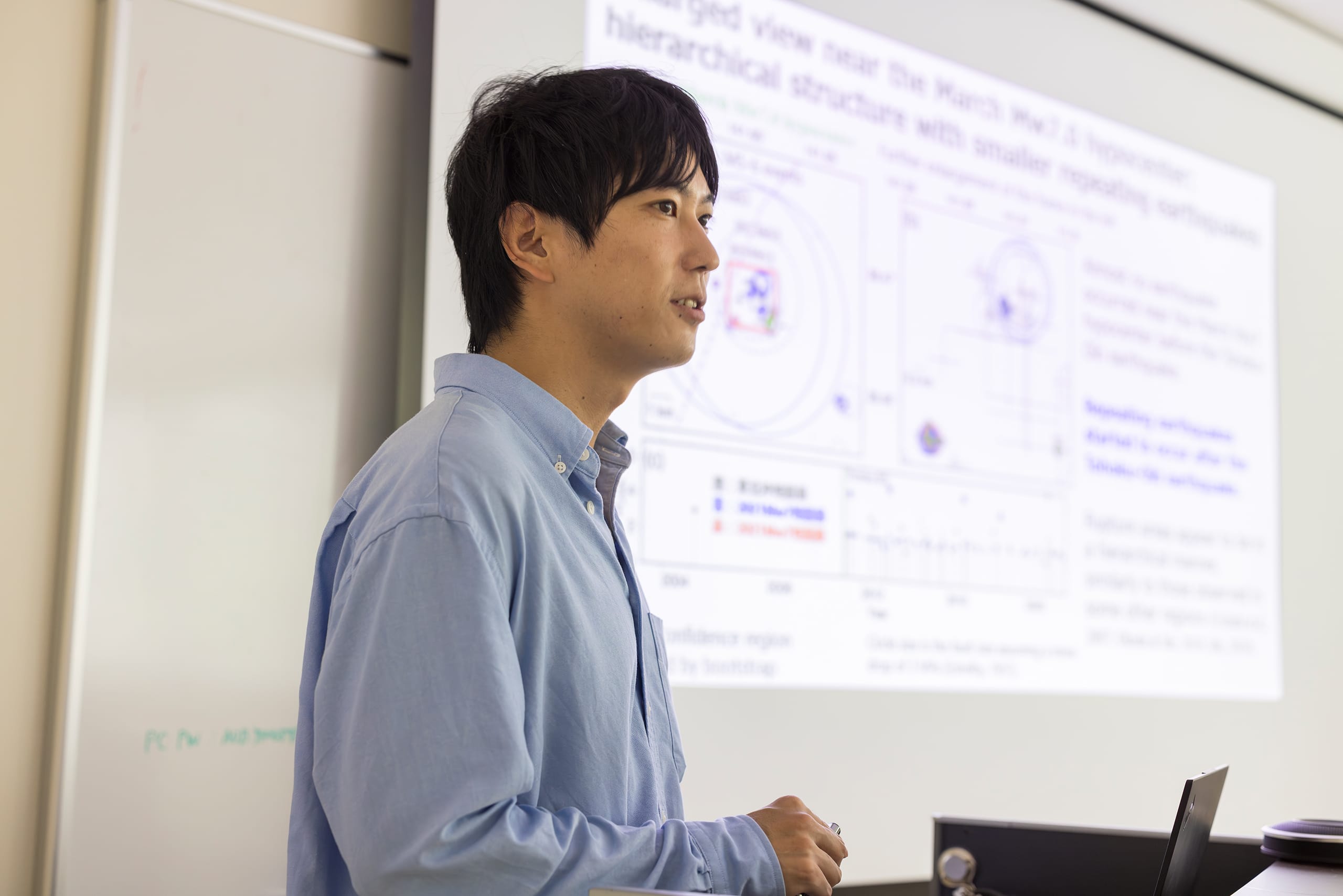
I analyze seismic waves from actual earthquakes occurring within the Earth in order to infer the general physical processes that underlie earthquake generation. In particular, I study earthquake source processes in terms of physical quantities such as stress and fault strength. Because stress, strength, and fluid conditions at depth cannot be measured directly, I adopt an approach that makes effective use of the characteristic features and background of each seismic sequence, extracting information in ways tailored to each target. At present, I focus on repeating earthquakes—events that recur on the same fault patch along the plate boundary of the Japan Trench. Using these data, I aim to clarify both the regular and irregular aspects of earthquake rupture and what they imply for the physics of fault slip. Specifically, I’m investigating what factors control where rupture starts, how it grows, when it stops, and what ultimately determines the final size of an earthquake. An important focus is to better understand the generation processes of past and future earthquakes along the Japan Trench, including the Miyagi-oki region. I’m also studying inland and intraslab earthquakes to explore how deformation within the plate is related to the stress field, and how crustal fluids influence fault strength and the earthquake generation process.

Expanding that “understandable part” little by little
- Keisuke YOSHIDA
- Associated Professor, Department of Geophysics
1.
What kind of research are you doing?
2.
What is the reason for starting your study?
My interest in earthquake processes began with two earthquakes that struck near my hometown when I was a student: the 2004 Mid-Niigata Prefecture Earthquake and the 2007 Niigata-ken Chuetsu-oki Earthquake, which occurred when I was in my final year of high school and my third year at university. Later, through studying the 2011 Tohoku-oki earthquake and its extensive triggered seismicity, I came to strongly recognize the importance of constraining crustal stress, fault strength, and the state of crustal fluids, which has led directly to my current research. More recently, while investigating the 2021 M7.0 earthquake off Miyagi, I became particularly interested in the irregular behavior found within repeating earthquakes—a rare class of seismic events that exhibit a degree of reproducibility. I am now focusing on how such irregularity can be used to extract information about the physical conditions that control earthquake generation.
3.
Message for prospective students
When I was a student, I had no intention of becoming a researcher, and I was quite adrift in many ways. Still, once I actually began doing research, and with the support of many mentors and senior colleagues, I gradually found my own ways of thinking and approaching problems. There were certainly difficulties along the way, but because I genuinely felt interested in what I was working on, I was able to push through them—and I think I became a little more resilient in the process. There are many things in the world that cannot be understood purely through logic, yet natural phenomena often contain aspects that can be explored logically. Expanding that “understandable part” little by little is, to me, one of the true pleasures of studying the natural sciences. By valuing the kinds of things that spark your curiosity or make you pause, and by paying attention to your own interests and inclinations, your own way of seeing and moving through the world—whether in scientific research or elsewhere—may gradually take shape.
- Name:
- Keisuke YOSHIDA
- Position:
- Associated Professor, Department of Geophysics
- Laboratory:
- Research Center for Prediction of Earthquakes and Volcanic Eruptions
- Hometown:
- Niigata
- Favorite Books:
- Crime and Punishment (Dostoevsky; since I first read it as a high school student)
- Research area:
- Earthquake generation mechanism
- Posted Date:
- Nov 27, 2025