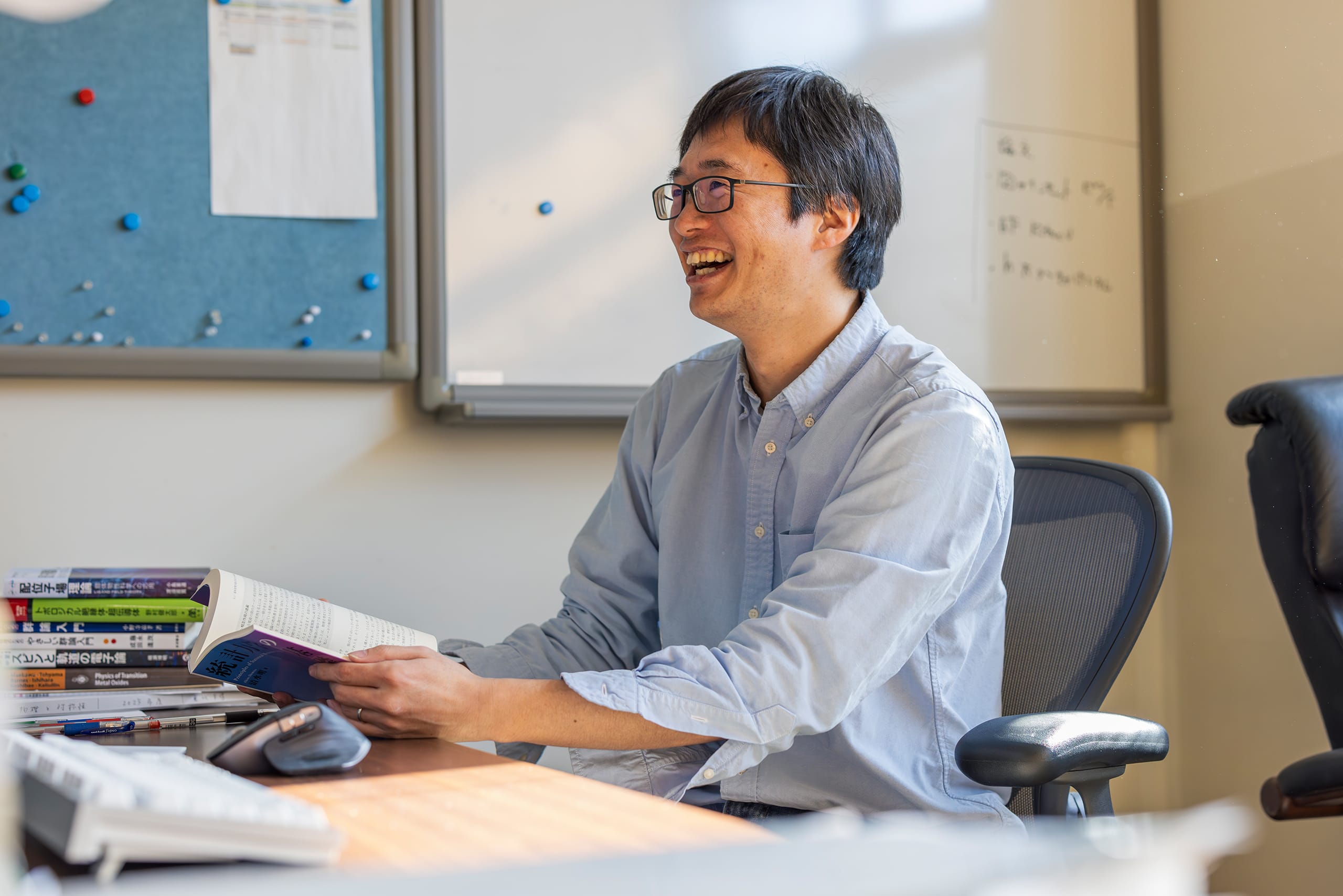
I study the motion of electrons in solids through analytical theoretical calculations and computer-based numerical simulations. Many phenomena observed in our everyday lives originate from electrons that constitute matter and from the electromagnetic interactions among them. In particular, solids contain an enormous number of electrons, comparable to Avogadro’s number, and their collective behavior gives rise to a wide range of properties that cannot be inferred from the behavior of a single electron alone. When the interactions between electrons become very strong, particle-like entities known as “quasiparticles” can emerge, exhibiting properties that are completely different from those of the original constituent particles. My research aims to clarify the conditions under which such quasiparticles appear, how they exist within materials, and how they can be observed experimentally. In addition, I theoretically explore the possibility of exploiting their unique properties to impart novel functionalities to materials.

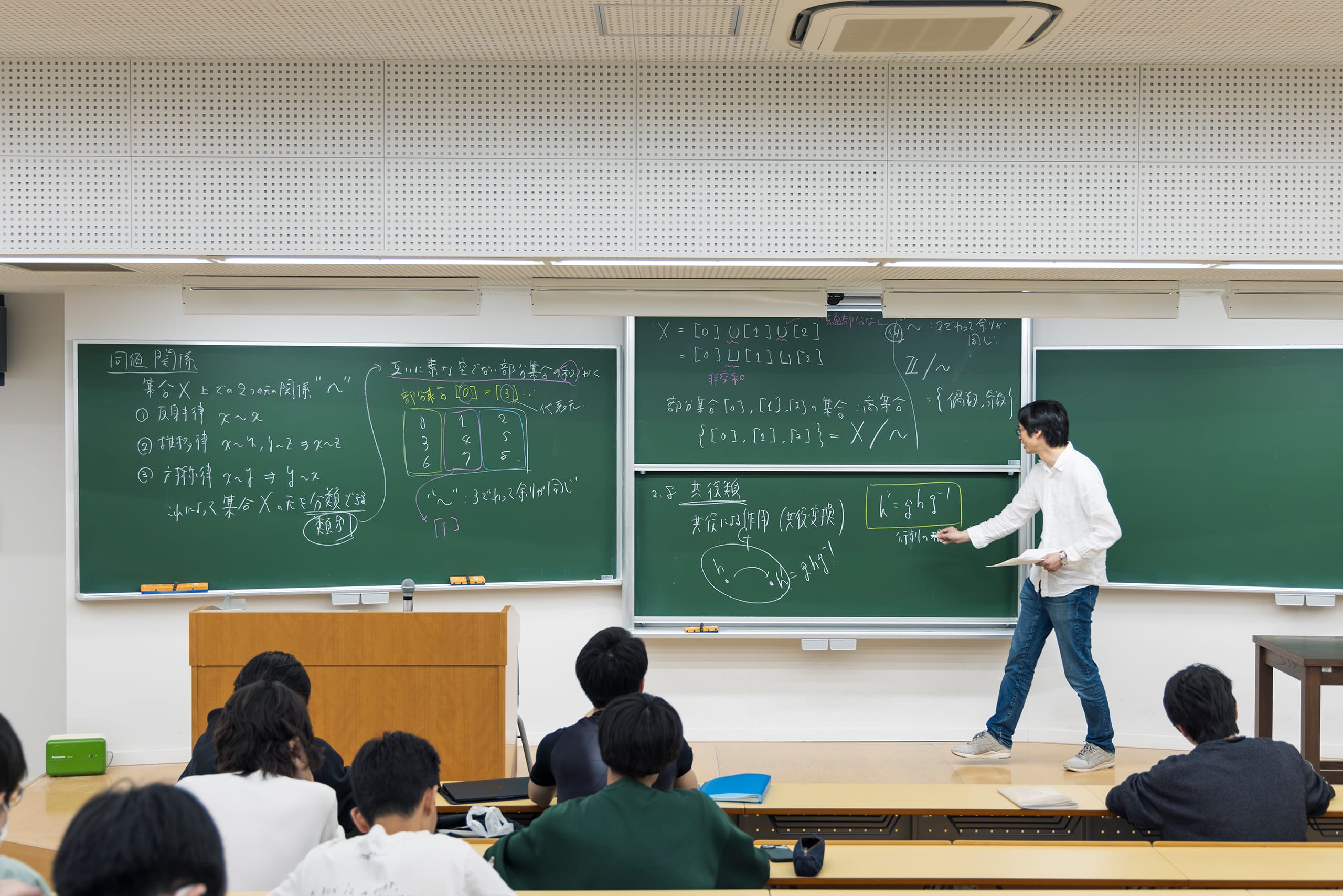
It provides an environment where one can take the time to learn deeply and devote oneself fully to research.
- Joji NASU
- Associate Professor, Department of Physics
1.
What kind of research are you doing?
2.
What is the reason for starting your study?
From an early age, I’ve enjoyed making things and spent time tinkering with electronic circuits. This naturally led me to a growing interest in technology-related fields, including semiconductors. I was also fascinated by the universe and vaguely hoped that I might one day be able to be involved in such areas. During high school, however, I often felt that the physics problems presented in textbooks were highly abstract and difficult to relate to real-world phenomena. In contrast, chemistry appealed to me because the phenomena under study were more concrete and easier to visualize. When applying for university, I hesitated between majoring in chemistry or physics. Ultimately, guided by my original interest, I chose to enroll in a physics department. After entering university, I became deeply attracted to particle physics and astrophysics. At the same time, I developed a strong desire to work on research topics that could be directly connected to phenomena in everyday life. Amidst this, lectures on statistical mechanics were particularly engaging, as they provided a framework linking microscopic laws to macroscopic behavior. This experience led me to pursue theoretical condensed matter physics as my field of study.
3.
Message for prospective students
I spent my student years in Sendai and experienced a major earthquake during that time. Afterward, I lived in the Tokyo metropolitan area for about ten years before having the opportunity to return to Sendai. When I came back after a long absence, I was struck by the significant changes the city and the university had undergone, including the opening of the subway and the development of the Aobayama Campus. On the other hand, I was reassured to find that the attitude of faculty members and students, who continue to engage sincerely in research and study, remained completely unchanged. In today's society, where trends and speed are emphasized, the academic world also seems to be influenced by this. Such tendencies could sometimes encourage research that is safe and similar in approach, potentially hindering truly original discoveries. Under these circumstances, I believe that Tohoku University is a rare and valuable institution. Located away from the rapid pace of major metropolitan centers, it provides an environment where one can take the time to learn deeply and devote oneself fully to research. Personally, I hope the younger generation in the Tohoku region will consider more than just moving to the Tokyo metropolitan area. I sincerely wish they would choose the path of devoting themselves to scholarship right here in Sendai.
- Name:
- Joji NASU
- Position:
- Associate Professor, Department of Physics
- Laboratory:
- Theoretical Condensed Matter and Statistical Physics Group
- Hometown:
- Yamagata
- Research area:
- Condensed matter physics, Solid state physics, Quantum many-body systems
- Posted Date:
- Jan 29, 2026