I study localized molecular vibrations that occur inside glass. In solids such as crystals or glass, energy (heat) is transported through the vibrations of molecules. In crystals, where molecules are arranged in an orderly fashion, these vibrations behave like spatially-extended waves, allowing us to construct a theory of heat transport.
In glass, however, its molecules are arranged in a highly disordered manner, and vibrations that do not exist in crystals–vibrations that are localized in space–emerge. This makes it difficult to build a satisfactory theory. Why do such localized vibrations emerge in glasses in the first place?
When faced with a phenomenon that is not yet well understood, physicists often turn to highly simplified models in order to grasp its essence. Following this strategy, I analyze a minimal “glassy” model that contains only the essential ingredients, in an attempt to uncover the origin of these mysterious localized vibrations.


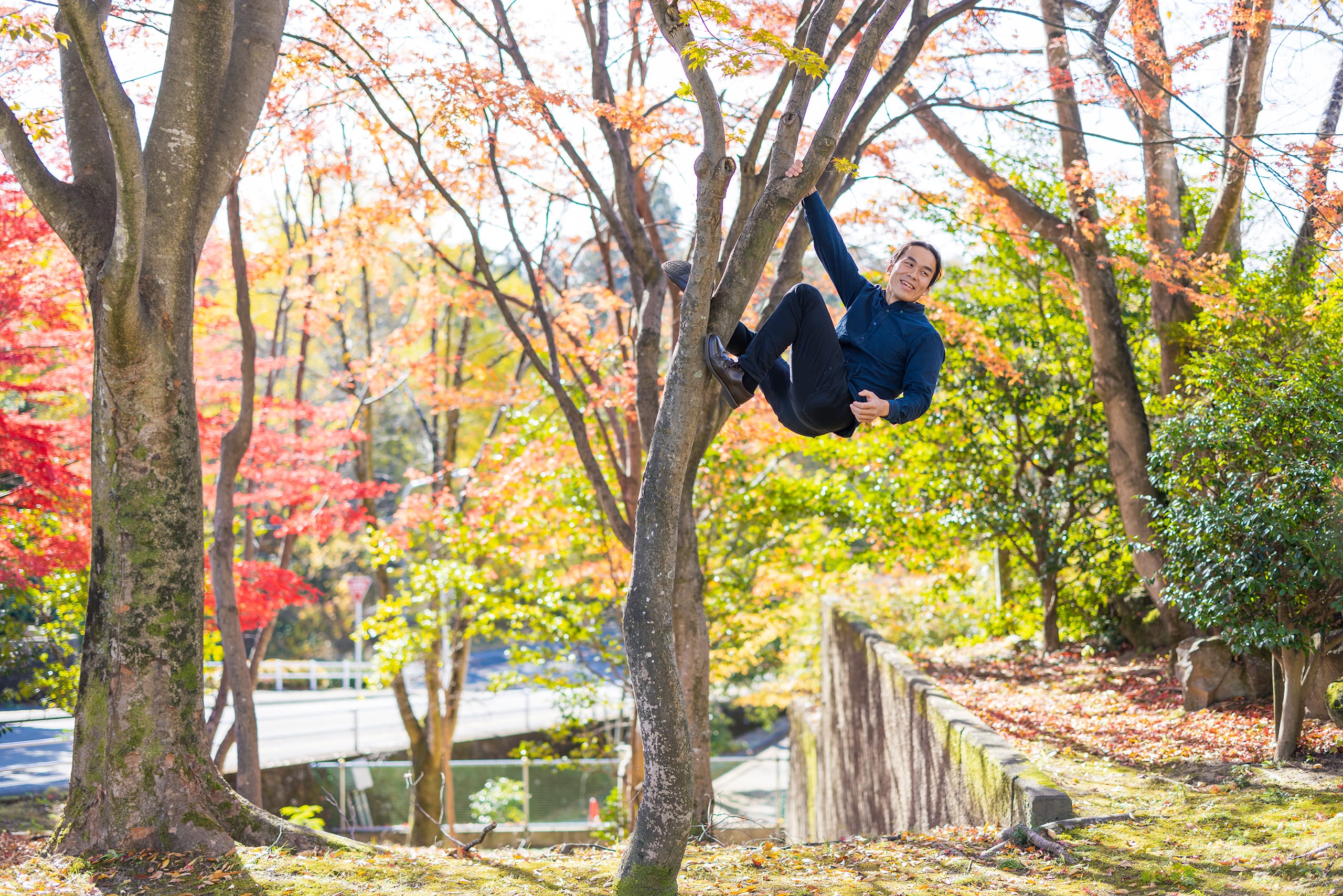
No wall is too small. What matters is keeping the spirit of challenge alive.
- Makoto SUDA
- 2nd year doctoral student in Department of Earth Sciences
1.
What kind of research are you doing?
2.
What is the reason for starting your study?
I originally entered the department of Earth science out of fascination for gigantic natural phenomena such as earthquakes and volcanic eruptions. But as I studied various subjects during my undergraduate years, I became increasingly intrigued by the small physical processes underlying these massive events.
These elementary processes interact in enormous numbers and give rise to the rich dynamics we observe in nature. Understanding how natural phenomena are built up from countless small components seemed deeply appealing to me.
At first I had no clear direction, but I came across a paper that caught my interest. I wrote an email to one of the authors, and he suggested I study vibrational phenomena in glasses. That was the beginning of my current research.
3.
Message for prospective students
It may be a worn-out expression, but I feel that research is similar to mountain climbing. As part of my mountaineering hobby I climb walls of rock or ice, and when I find an attractive wall that no one has climbed before, I think hard about how to climb it and then attempt it–though success is never guaranteed.
Isn’t this equivalent to thinking of an effective approach toward a research goal and then trying it out? Challenges to the unknown always come with a certain sense of fear, but the feeling of accomplishment when things work out is all the greater. It becomes addictive.
No wall is too small. What matters is keeping the spirit of challenge alive.
- Name:
- Makoto SUDA
- Position:
- 2nd year doctoral student in Department of Earth Sciences
- Laboratory:
- Fault & Geodynamics
- Hometown:
- Kanagawa
- Favorite Books:
- Climbing Guide to Japanese Mountains 1: Hokkaido & Tohoku
- Research area:
- Statistical physics of glasses
- Posted Date:
- Dec 23, 2025