
NEWS
Violent merging process shapes "quiescent" galaxies in the early universe
Astronomers have long been intrigued by "quiescent" galaxies -- massive galaxies that have shut down most of their star formation. Often called "red and dead," they appear quiet, yet observations show that these galaxies somehow continue to grow over cosmic time. The mystery is: how can galaxies grow when they've stopped forming stars?
Thanks to the James Webb Space Telescope (JWST)(1), scientists are now getting a closer look at these galaxies than ever before. With its sharp infrared vision, JWST can reveal the fine details of the galaxies that formed more than 12 billion years ago, when the Universe was still young.
Using JWST images, we applied a cutting-edge technique called spatially resolved spectral energy distribution (SED) fitting. This technique allows us to map how stellar mass and star-formation activity are distributed across a galaxy. The analysis reveals a striking story: as can be seen in Figure 1,the outskirts of quiescent galaxies have expanded dramatically, making these galaxies more than five times larger in size compared to their compact forms 12 billion years ago. This result confirms that these galaxies do not remain "frozen" after they stop forming stars, but instead continue to evolve structurally.
The small amount of residual star formation inside these galaxies is far too weak to account for the new stellar masses appearing in their outer regions. This strongly suggests that the outskirts of quiescent galaxies were not built internally, but instead through external processes such as mergers. More importantly, based on the observed size evolution of these galaxies, we found evidence that the dominant merger mechanism changes over time. Figure 2 shows the schematic diagram. In the early universe (more than 10 billion years ago, the relatively steady and gradual size growth is best explained by violent major mergers between galaxies of comparable mass. After about 10 billion years ago (around redshift 2), however, more gentle minor mergers became the main driver of growth, leading to a more pronounced increase in size. This result is particularly new, as most previous studies have only examined this transition up to 10 billion years ago, whereas our work pushes the picture further back in time.
Furthermore, the cores of these galaxies appear to have been fully established very early on. Their stellar mass density has remained almost constant for over 12 billion years. This means the inner regions of massive galaxies formed rapidly in the early universe and have remained stable ever since.
Taken together, these findings support a scenario where galaxies are most compact immediately after they quench their star formation. Over billions of years, they grow larger and more massive not by building new stars in their centers, but by gradually assembling material onto their outskirts--first through major mergers, and later through minor ones. This discovery sheds new light on the long-term evolution of the Universe's most massive galaxies, which today dominate the population of giant elliptical galaxies.
The result is published as "Stellar Mass Assembly History of Massive Quiescent Galaxies since z∼4 : Insights from Spatially Resolved SED Fitting with JWST Data", Astrophysical Journal.
This publication was supported by the Tohoku University Support Program for the Article Processing Charges (APC) FY2025.
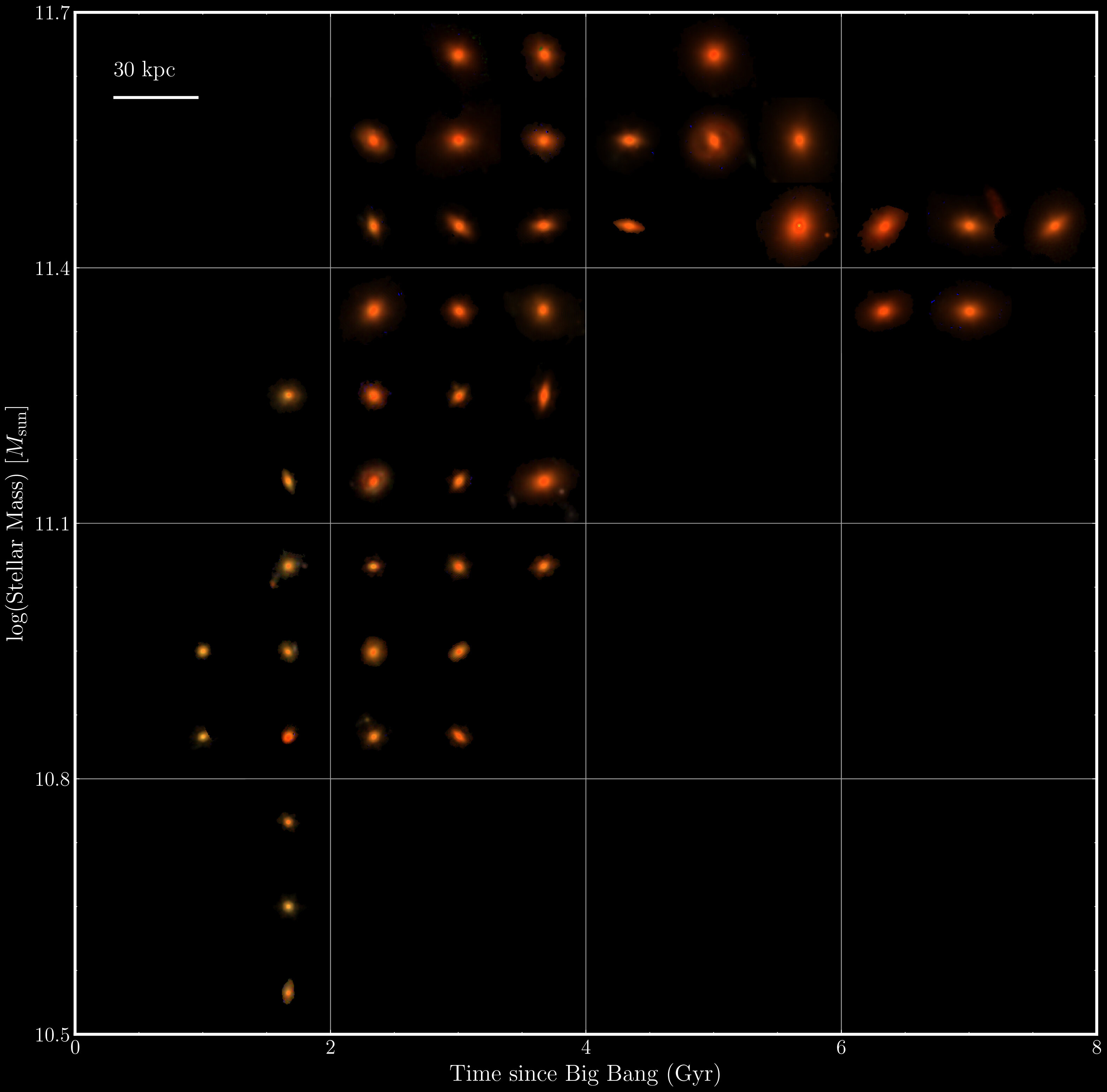
Figure 1: Images of the most massive quiescent galaxies, shown as a function of their stellar mass (vertical axis) and the time when they are observed (horizontal axis). The bar at the top represent the size of the Milky Way galaxy. Galaxies in the early universe are compact, and galaxies closer to us are larger and extended. Their stellar mass has remained nearly constant since about 3.5 billion years after the Big Bang.
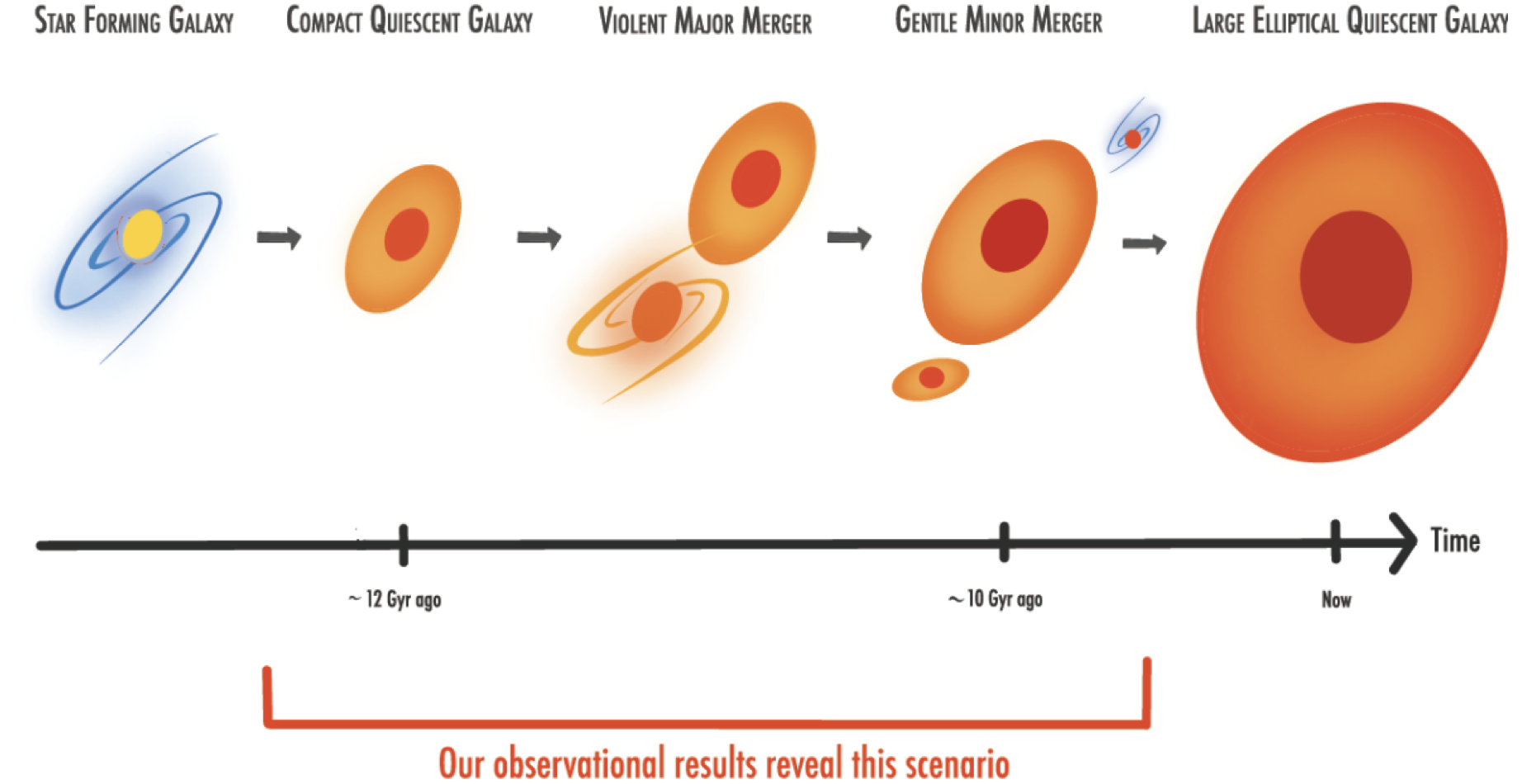
Figure 2: Formation of massive quiescent galaxy. After star formation ceases, galaxies are compact and quiescent --the most compact stage of their lifetime. Over time, they grow in size and mass by merging with galaxies with comparable size at first, and accreting surrounding small galaxies in later stages, eventually becoming the large, massive quiescent galaxies observed in the local Universe.
Publication Details:
Title: Stellar Mass Assembly History of Massive Quiescent Galaxies since z∼4: Insights from Spatially Resolved SED Fitting with JWST Data
Authors: Novan Saputra Haryana, Masayuki Akiyama, Abdurro'uf, Hesti Retno Tri Wulandari, Juan Pablo Alfonzo, Kianhong Lee, Naoki Matsumoto, Ryo Albert Sutanto, Muhammad Nur Ihsan Effendi, Itsna Khoirul Fitriana, Ibnu Nurul Huda, Anton Timur Jaelani, Sultan Hadi Kusuma, Lucky Puspitarini, Dian Puspita Triani
Journal: The Astrophysical Journal
DOI: 10.3847/1538-4357/ae03ad
Contact:
Novan Saputra Haryana
Astronomical Institute, Tohoku University
Email: novan.haryana * astr.tohoku.ac.jp (Replace * with @)
Website: https://www.astr.tohoku.ac.jp/en/index.html