
NEWS
Next-Generation Adaptive Optics ULTIMATE-START Begins Test Observations at the Subaru Telescope
Test observations of the next-generation adaptive optics system ULTIMATE-START were conducted at the Subaru Telescope in December 2025. The system was developed through collaboration between Tohoku University and the National Astronomical Observatory of Japan (NAOJ),
One of the major challenges for ground-based astronomical observatories such as the Subaru Telescope on Maunakea, Hawaii is turbulence in Earth's atmosphere. As starlight passes through the atmosphere, it is distorted by turbulent air--similar to the shimmering effect seen above a hot surface--causing stars to appear blurred. Adaptive optics is a technology designed to correct this problem. It measures atmospheric distortions in real time and rapidly adjusts the shape of a special mirror to cancel them out, allowing telescopes to produce much clearer views of the universe.
Traditionally, a single artificial laser guide star is created by projecting a laser beam into the upper atmosphere, and the atmospheric turbulence is measured using this as a reference star. A newer technique known as laser tomography adaptive optics employs a constellation of four laser guide stars in the sky. By analyzing the incoming light from these guide stars, the system can reconstruct a three-dimensional model of atmospheric turbulence and apply more optimal corrections. This technique enables sharper views of the universe than is possible with a single laser guide star.
Details of the test observations are available on the website of the Subaru Telescope, National Astronomical Observatory of Japan. (LINK)
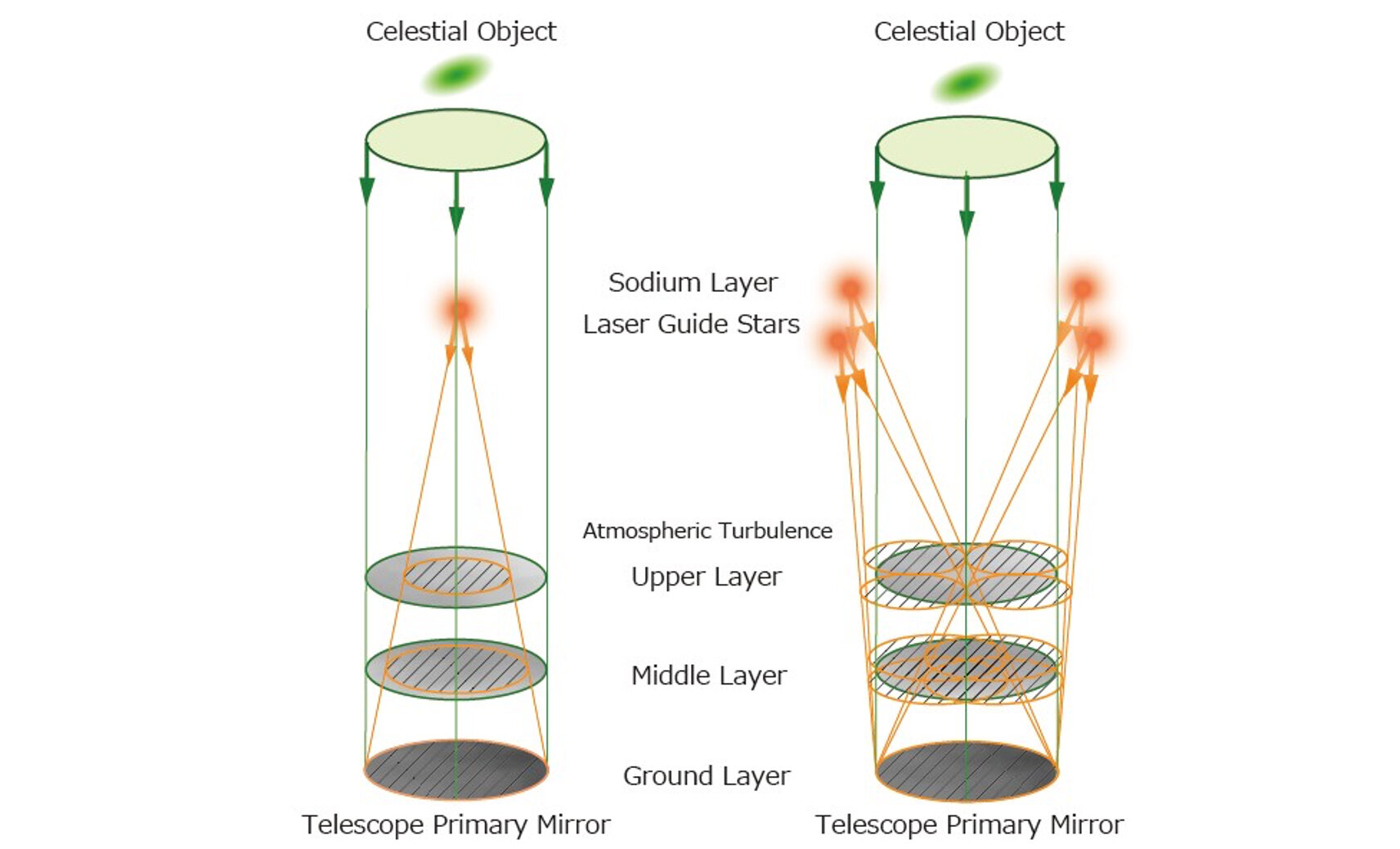
Figure 1: Schematic diagram of atmospheric turbulence correction using laser guide stars. The left panel shows the case with one laser guide star, while the right panel shows laser tomography adaptive optics using four laser guide stars. Green lines represent light from the observed celestial object, and orange lines represent light from laser guide stars created at an altitude of about 90 km. Gray disks represent atmospheric layers through which the starlight passes (upper layer around 10 km, middle layer around 5 km, and ground layer near the surface). Using four laser guide stars expands the regions where atmospheric turbulence can be measured (hatched disks) and allows turbulence at different altitudes to be reconstructed separately. (Credit: Masayuki Akiyama)
Contact:
Masayuki Akiyama
Astronomical Institute, Tohoku University
Email: akiyama * astr.tohoku.ac.jp (Replace * with @)
Website: https://www.astr.tohoku.ac.jp/en/index.html